Neutralization
Understanding the thread-neutralization protocol. The protocol is platform-specific (POSIX uses signal delivery; Windows uses SuspendThread/ResumeThread), but the API is identical on both platforms.
State Machine
Overview
Neutralization solves the stalled thread problem: what happens when a thread stays pinned for a long time? Without intervention, it blocks reclamation and memory accumulates unboundedly.
DEBRA+ uses POSIX signals (or, on Windows, SuspendThread/ResumeThread) to neutralize stalled threads, allowing epoch advancement and bounded memory.
The Stalled Thread Problem
If a thread stays pinned at an old epoch:
- Reclamation is blocked indefinitely
- Memory accumulates in limbo bags
- System may run out of memory
How Neutralization Works
POSIX (Linux, macOS, BSD)
- Detection: Reclamation detects thread pinned at old epoch
- Signal: Send SIGUSR1 to stalled thread (
pthread_kill) - Handler: Signal handler runs asynchronously in the target's
context and flips
pinned=false,neutralized=truefor the target's slot - Check: Thread observes the flag on next pin attempt
- Acknowledge: Thread acknowledges neutralization
- Advance: Safe epoch can now advance past stalled thread
Windows
- Detection: Reclamation detects thread pinned at old epoch
- Suspend: Scanner calls
SuspendThreadon the target's duplicated handle - Flip: Scanner directly walks the manager's
threads[]array and flipspinned=false,neutralized=truefor the target's slot - Resume: Scanner calls
ResumeThread - Check: Thread observes the flag on next pin attempt
- Advance: Safe epoch can now advance past stalled thread
The Windows arm is semantically equivalent to the POSIX arm — both result in the target slot being flipped. The difference is that the flip happens synchronously on the scanner side (Windows) rather than asynchronously in the target's context (POSIX). The same byte-stride descriptor is used for the slot walk on both platforms.
Triggering Neutralization
The simple convenience API allows scanning for and signaling stalled threads:
This returns the number of signals sent to stalled threads.
The epochsBeforeNeutralize parameter controls how far behind a thread must be before neutralization (default is 2 epochs):
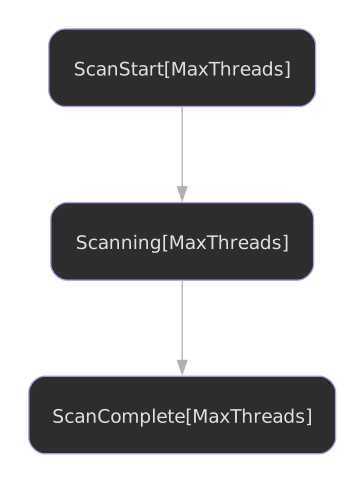
For advanced use cases, the low-level typestate API provides explicit control over each step:
let complete = scanStart(addr manager)
  .loadEpoch(epochsBeforeNeutralize = 2)
  .scanAndSignal()
let count = complete.extractSignalCount()
Neutralization Handling Example
Example source not mirrored
The examples/neutralization_handling.nim source was part of the standalone
nim-debra repo and is not included in this frozen mirror. View it at
the upstream link below, or see the live
SMR guide for the current lockfree/smr/nebr API.
:material-file-code: View full source
Neutralization Semantics
Neutralization is advisory, not forceful:
- Thread is not stopped mid-computation
- Thread is not killed or interrupted
- Thread continues running normally
- Flag is checked on next unpin
Safety Guarantees
- Neutralization cannot corrupt memory
- Thread completes current operation safely
- Lock-free operations remain atomic
- Memory ordering is preserved
Limitations
Neutralization cannot:
- Stop a thread in an infinite loop
- Interrupt blocking system calls
- Force a thread to check the flag
- Guarantee timely response
Configuration
Neutralization Threshold
How far behind before neutralizing? Default is 2 epochs.
Lower threshold = more aggressive neutralization, better memory bounds, more interruptions.
Higher threshold = more lenient on long operations, higher memory usage, fewer interruptions.
Signal Choice (POSIX only)
DEBRA+ uses SIGUSR1 by default on POSIX. Requirements:
- Must not be used by application
- Must not have default handler
- Must be available on platform
On Windows there is no signal involved; neutralization uses
SuspendThread / ResumeThread and no signal number is consumed.
Platform Considerations
Neutralization is supported on:
- POSIX (Linux, macOS, BSD): via
pthread_kill+ SIGUSR1 async handler. - Windows: via
SuspendThread/ResumeThreadinvoked synchronously by the scanner. Added in v0.10.0.
The API surface is identical on both platforms; the implementation
detail is hidden behind debra/signal.neutralizeRemoteSlot.
Deadlock Constraint (Both Platforms)
Do NOT invoke DEBRA reclamation while holding a lock that other DEBRA-using threads might be blocked on. The constraint exists on both platforms but the mechanism differs:
- POSIX: the SIGUSR1 handler runs in the target's context and may need to acquire shared state.
- Windows: the scanner blocks briefly inside
SuspendThread(kernel call), then walks the manager directly. The risk is the target holding a lock that the scanner needs after this call.
Either way, the safe pattern is to keep DEBRA reclamation and application-level locks disjoint.
Best Practices
Keep Critical Sections Short
Avoid neutralization by keeping pin/unpin sections minimal:
# GOOD - short critical section
let pinned = unpinned(handle).pin()
let node = queue.dequeue()
discard pinned.unpin()
processNode(node)  # Outside critical section

# BAD - long critical section
let pinned = unpinned(handle).pin()
let node = queue.dequeue()
processNode(node)  # Inside critical section!
discard pinned.unpin()
Handle Neutralization Gracefully
Don't treat neutralization as an error - retry the operation.
Monitor Neutralization Rate
Frequent neutralization indicates:
- Critical sections are too long
- Operations are blocking
- Threshold is too aggressive
Next Steps
- Learn about integration patterns
- Review API reference